



Welcome to Malagentia
The Province of Malagentia is a local chapter of the Society for Creative Anachronism, a living history organization devoted to the study and recreation of the Middle Ages and Renaissance. We are a branch of the East Kingdom, located in Southern Maine.
Are you new to the SCA or just want to learn more about this non-profit organization? Click on the link below to contact our newcomer guide, or “Chatelaine!” They can answer your questions, or help you find answers!
Malagentia holds monthly (except August) business meetings on the first Thursday of the month. Meetings are currently being held online. Malagentia has two “ridings” (sort of like a state has counties): Ravensbridge, in the greater Augusta/Lewiston-Auburn area, and Giggleswick, in Southern York County.
Get updates from us via email!
History
Although it seems likely that Norse explorers had visited our lands previously, in the year 1524, Italian navigator Giovanni da Verrazano and the crew of the La Dauphine were the first visitors to what is now our coastline to leave a written record of their visit.
As Verrazano reported to King Francis I,

“We found a high land and full of very thick forests, the trees of which were pines, cypresses, and such as grow in cold regions. The people … were full of uncouthness and vices, so barbarous that we were never able, with howsuover many signs we made them, to have any intercourse with them. . . . If, trading at any time with them, we desired their things, they came to the shore of the sea upon some rock where it was veyr steep we remaining in the small boat – with a cord let down to us what they wished to give, continually crying on the land that we should not ap- proach, giving quickly the barter, nor taking in exchang for it except knives, hooks for fishing, and sharp metal. They had no regard for courtesy, and when they had nothing more to exchange, at their departing the men made at us all the signs of contempt and shame which any brute creature could make, such as showing their bare buttocks and laughing imoderately.”
As translated and quoted in North America: The Historical Geography of a Changing Continent, 2001.
In 1529, the explorer’s brother, Girolamo de Varrazano, created a map documenting the travels of La Dauphine, and labeled the coast of Casco Bay as Terra Onde di Mala Gente – the land of the bad people. While our province name, “Malagentia,” translates to “Land of the Bad People,” please don’t let that discourage you! We are the biggest-hearted bad people you’ll ever meet!

What is the SCA?
The Society for Creative Anachronism, Inc. (SCA) is a non-profit educational organization devoted to study of dedicated to researching and re-creating the arts, skills, and traditions pre-17th-century. Most of its activities take place in the context of a social structure adapted from the forms of the European Middle Ages, which allows participants to take a first-hand look at various aspects of the life, culture and technology of the times under study. It is part of the “living history” movement, which means that members try to reproduce various aspects of the culture and technology of their period, as well as doing more traditional historical research.
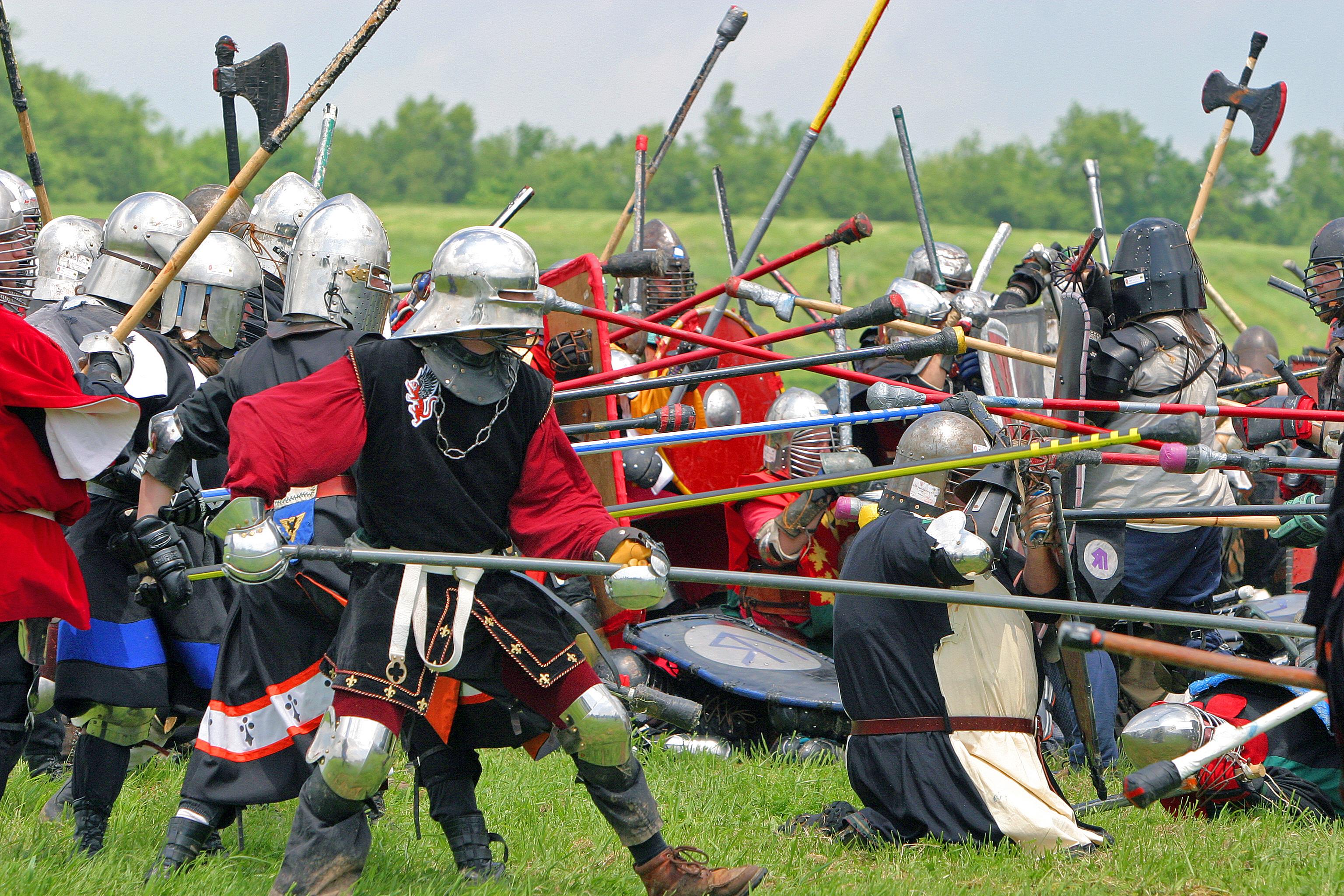
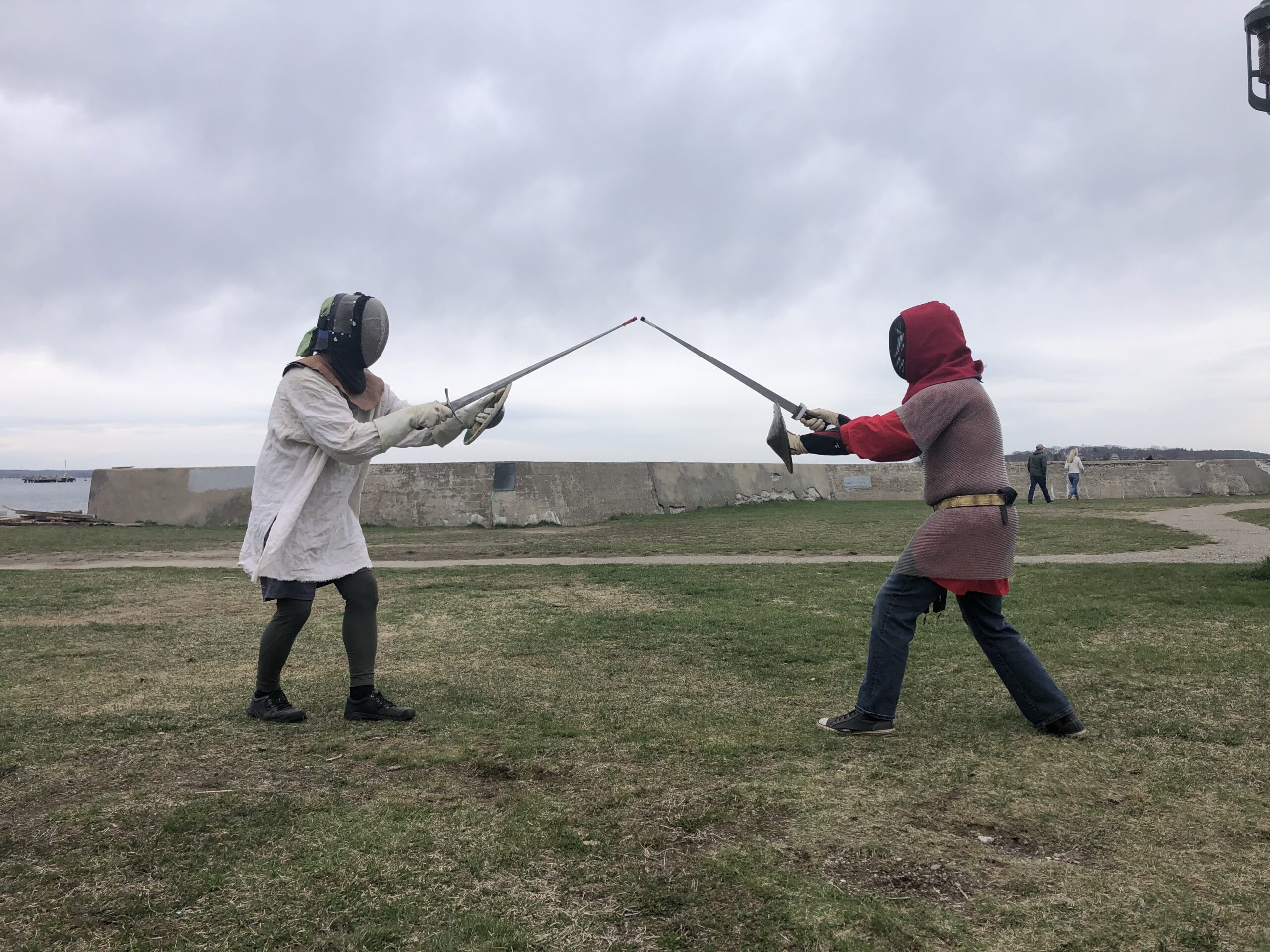
The SCA sponsors events such as tournaments, feasts, and university sessions where folks dress according to medieval and Renaissance styles, and participate in activities based on the civil and martial skills of the period. Events have a number of focal areas, including combat (heavy armor/weapons, fencing, combat archery), costuming, armoring, archery, thrown weapons (axes, spears and knives), calligraphy, dancing, music, cookery, and board and field games, plus a variety of technical and social skills which help establish the ambiance of life at a period court. Society events are open to the public, but, in keeping with the emphasis on living history rather than dramatic performance, all attendees are expected to make an attempt to preserve the atmosphere and fit in with the SCA’s standards of dress and behavior. We also regularly hold less formal and more locally accessible practices and get-togethers, working on areas including fencing, heavy combat, dancing, calligraphy and illumination, archery, thrown weapons and more.
Our activities range very widely, including a much broader span of time and culture than most groups in the “living history” movement try to sample. The people we’ve chosen for models were fond of play-acting and pageantry; they would happily base tournaments and revels on ancient history and distant lands, so we can use themes from outside medieval and Renaissance Europe. They also reached remote parts of the world, despite the limits of their technology, and people born to other civilizations traveled too, so we can allow for individuals and information from almost anywhere. The task is to weave all this together, so that the events we sponsor are recognizably our own.
There are tens of thousands of active SCA participants, who administrate local chapters of the SCA in all fifty states, plus dozens of countries abroad. There are over 30,000 paid members of the corporation, and the total number of participants is around 60,000 people.
THE SCA PROHIBITS HARASSMENT AND BULLYING OF ALL INDIVIDUALS AND GROUPS. Participants engaging in this behavior are subject to appropriate sanctions. If you are subjected to harassment, bullying or retaliation, or if you become aware of anyone being harassed or bullied, contact a seneschal, President of the SCA, or your Kingdom’s Board Ombudsman.